

Coat colours
The FCI standard lists four colours, the AKC show standard three. This page shows each colour, what the two documents say about it, and how they differ.
An Atlas educational summary. It has not been reviewed or approved by the FCI or the AKC, and it is not an official translation.
The four colours at a glance
-
 Black
FCI ✓ · AKC ✓
-
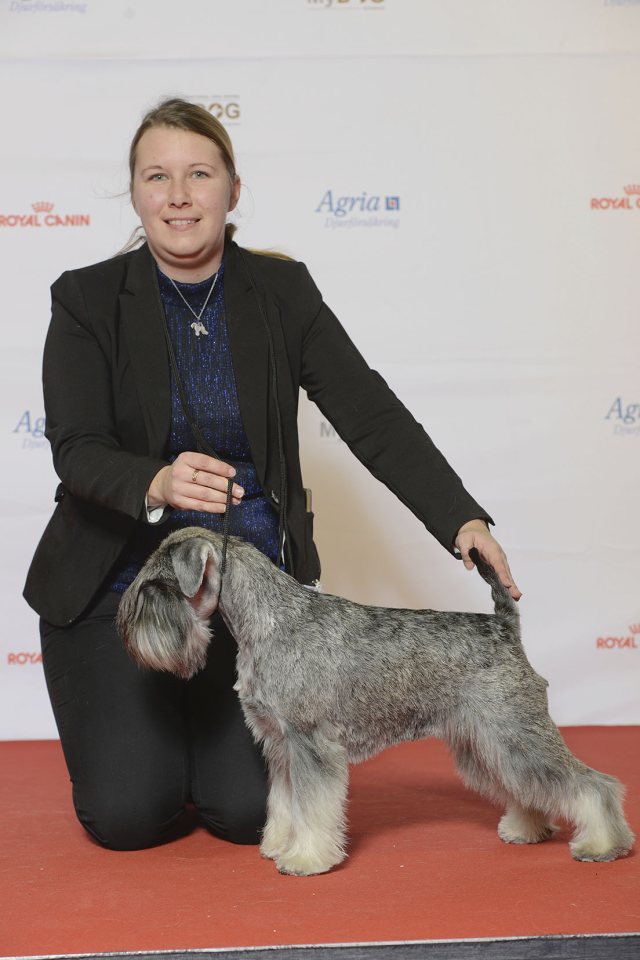 Pepper & Salt
FCI ✓ · AKC ✓
-
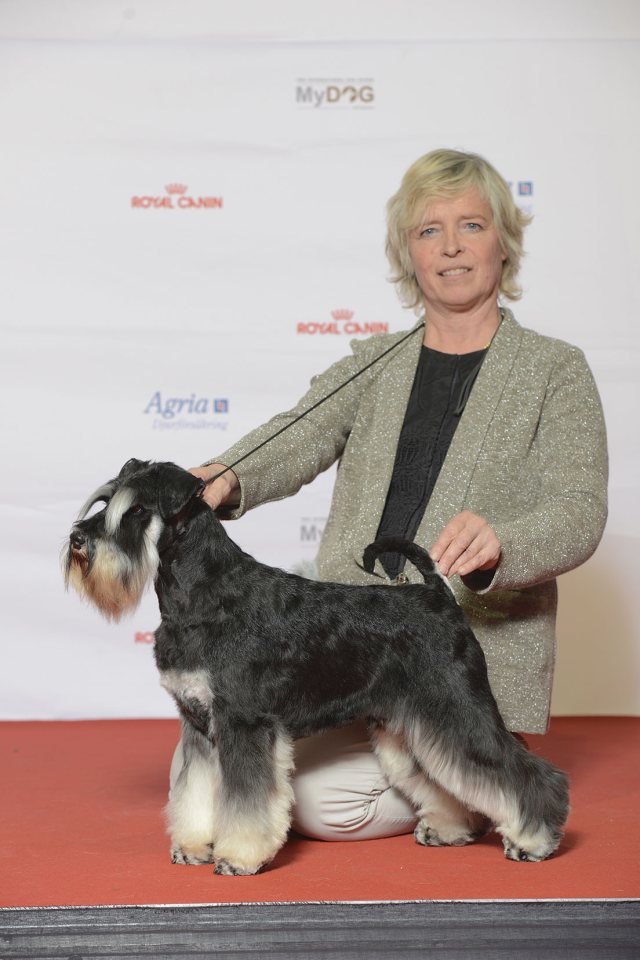 Black & Silver
FCI ✓ · AKC ✓
-
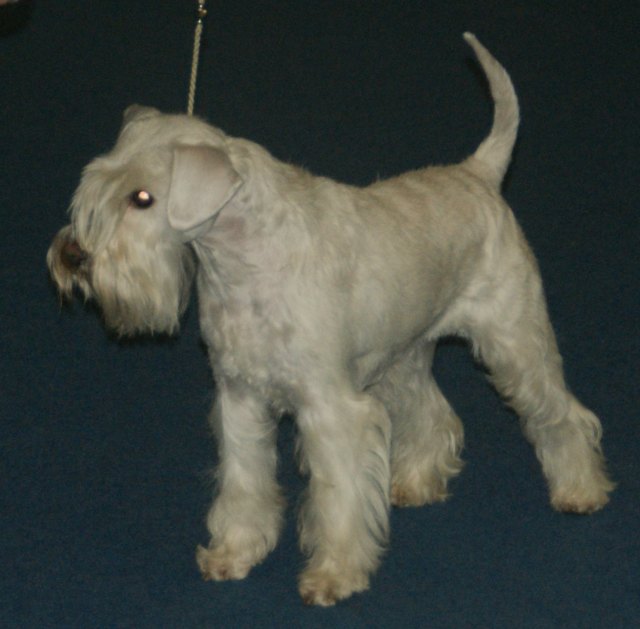 White
FCI ✓ · AKC ✕
The photographs are examples chosen by hand from freely licensed material (author, licence and source under each one). Each shows what its caption says and nothing more: none is presented as an ideal dog, and a photograph shows the colour only as well as the light, the camera and the screen allow.
Black
FCI Listed in the FCI standard "Pure black with black undercoat."
AKC Allowed in the AKC standard "Black is the only solid color allowed."
Black Miniature Schnauzer standing in profile: a uniformly black coat on body, legs and furnishings; drop ears folded forward; tail carried up and curved.
Sale23 · CC BY-SA 3.0 · Wikimedia Commons
Source and licence of the picture
- Author
- Sale23 · 2012-11-05
- Licence
- CC BY-SA 3.0
- Dog
- The dog's name is not given in the source; no link to an Atlas profile.
- Changes
- Re-encoded as JPEG from the file shown on Commons; not cropped, not retouched.

Another black Miniature Schnauzer posed on a rock, side view: the black stays the same on the body and legs; ears hang forward and the tail is carried upright.
Sale23 · CC BY-SA 3.0 · Wikimedia Commons
Source and licence of the picture
- Source
- https://commons.wikimedia.org/wiki/File:Patuljasti_snaucer_miniature_schnauzer_zwergschnauzer.jpg
- Author
- Sale23 · 2011-08-11
- Licence
- CC BY-SA 3.0
- Dog
- The dog's name is not given in the source; no link to an Atlas profile.
- Changes
- Re-encoded as JPEG from the file shown on Commons; not cropped, not retouched. The photographer's mark in the corner of the original is left as it is.
FCI: pure black with a black undercoat; a brown undercoat is a fault, and a white or spotted coat in black dogs is a serious fault.
AKC: ideally a true, rich, glossy black topcoat with a softer, less intense black undercoat — "natural and should not be penalized". The stripped (plucked) parts are free from fading or brown tinge. A small white spot on the chest is permitted, as is an occasional single white hair elsewhere on the body.
Pepper & Salt
FCI Listed in the FCI standard "Pepper and Salt."
AKC Allowed in the AKC standard "Salt and pepper" (the AKC order of the words).

Pepper and salt Miniature Schnauzer shown in profile in a show stance with its handler: the grey, peppered body coat and the lighter furnishings on the beard, chest and legs.
Svenska Mässan · CC BY 2.0 · Wikimedia Commons (from Flickr)
Source and licence of the picture
- Author
- Svenska Mässan (Svenska Mässan (MyDOG)) · 2016-01-07
- Licence
- CC BY 2.0
- Dog
- Named in the source as "La Leia’s Fabulos Fixa" (photo title: "BIR Grupp 2", MyDOG, Sweden, 7 January 2016). The source gives no registration number, so no link to an Atlas profile is made.
- Changes
- Re-encoded as JPEG and also offered at 640 px width; not cropped (the handler and the sponsors' backdrop stay in the picture).

Pepper and salt Miniature Schnauzer in show trim at an AKC show: the banded grey topcoat and the lighter beard, eyebrows and leg furnishings. The ears are cropped (pointed, upright).
SheltieBoy (Ron Armstrong) · CC BY 2.0 · Wikimedia Commons (from Flickr)
Source and licence of the picture
- Author
- SheltieBoy (Ron Armstrong) · 2013-09-19
- Licence
- CC BY 2.0
- Dog
- The dog's name is not given in the source; no link to an Atlas profile.
- Changes
- Resized from the original (4198 × 4885 px) to 1280 px width and re-encoded as JPEG; also offered at 640 px; not cropped.

Pepper and salt Miniature Schnauzer in a pet clip, standing in profile outdoors, with natural drop ears and a natural tail carried upright — the ears and tail the FCI standard describes.
Canarian · CC BY-SA 3.0 · Wikimedia Commons
Source and licence of the picture
- Author
- Canarian · 2009-05-24
- Licence
- CC BY-SA 3.0
- Dog
- The dog's name is not given in the source; no link to an Atlas profile.
- Changes
- Resized from the original (2288 × 1520 px) to 1280 px width and re-encoded as JPEG; also offered at 640 px; not cropped.
FCI: when breeding pepper and salt the aim is a medium shading with evenly distributed, well-pigmented pepper colouring and a grey undercoat. Shades from dark iron grey to silver grey are all permitted. In all colour variations there must be a dark mask; distinct light markings on head, chest and limbs are undesirable.
AKC: the colour comes from black-and-white banded hairs together with solid black and solid white hairs, the banded hairs predominating; all shades from light to dark are acceptable, with tan shadings permissible. The mixture fades to light grey or silver-white on the eyebrows, whiskers, cheeks, under the throat, inside the ears, across the chest, under the tail, on the leg furnishings and inside the hind legs.
Black & Silver
FCI Listed in the FCI standard "Black/Silver."
AKC Allowed in the AKC standard "Black and silver."

Black and silver Miniature Schnauzer in a show stance with its handler, seen in profile: the black body with silver-white on the beard, eyebrows, chest and the lower legs and feet.
Svenska Mässan · CC BY 2.0 · Wikimedia Commons (from Flickr)
Source and licence of the picture
- Author
- Svenska Mässan (Svenska Mässan (MyDOG)) · 2016-01-07
- Licence
- CC BY 2.0
- Dog
- Named in the source as "Steadlyn Yes Indeed" (photo title: "BIR Grupp 2", MyDOG, Sweden, 7 January 2016). The source gives no registration number; Atlas has other dogs of the Steadlyn kennel but none is identified with this one, so no link is made.
- Changes
- Re-encoded as JPEG and also offered at 640 px width; not cropped.

A second black and silver Miniature Schnauzer in a show stance: the black topcoat and the silver-white markings on the beard, chest and legs.
Svenska Mässan · CC BY 2.0 · Wikimedia Commons (from Flickr)
Source and licence of the picture
- Author
- Svenska Mässan (Svenska Mässan (MyDOG)) · 2016-01-08
- Licence
- CC BY 2.0
- Dog
- Named in the source as "Mandalay’s Martini" (MyDOG, Sweden, 8 January 2016). The source gives no registration number; none of the dogs with a similar name in Atlas is identified with this one, so no link is made.
- Changes
- Re-encoded as JPEG and also offered at 640 px width; not cropped.

Black and silver Miniature Schnauzer in profile at the CACIB show in Tallinn (17–18 August 2013): the black body, the silver-white patch on the chest and the silver on the muzzle and lower legs.
Томасина · CC BY-SA 3.0 · Wikimedia Commons
Source and licence of the picture
- Author
- Томасина · 2013-08-17
- Licence
- CC BY-SA 3.0
- Dog
- The dog's name is not given in the source; no link to an Atlas profile.
- Changes
- Re-encoded as JPEG and also offered at 640 px width; not cropped.
FCI: the breeding aim is a black topcoat with black undercoat and white markings over the eyes, on the cheeks, at the beard, at the throat, in two separate triangles at the front of the chest, on the front pasterns, on the feet, on the inside of the hind legs and around the anus. Forehead, neck and the outer sides of the ears should be black like the topcoat. Triangles on the chest that are not clearly separated are a fault.
AKC: follows the same pattern as salt and pepper, but the whole salt-and-pepper section must be black. The black of the topcoat is a true rich colour with a black undercoat; the stripped parts are free from fading or brown tinge and the underbody should be dark.
White
FCI Listed in the FCI standard "Pure white with white undercoat."
AKC Not an allowed colour in the AKC standard Not among the allowed colours.

White adult Miniature Schnauzer standing on a lead, seen from the side and slightly from the front: the whole body with the ears, the tail carried up and all four feet. In this indoor light the coat looks cream-white, and the dark background and the lighting make the detail of the white hair less clear than in the other photographs.
Canarian · CC BY-SA 4.0 · Wikimedia Commons
Source and licence of the picture
- Author
- Canarian · 2018-12-15
- Licence
- CC BY-SA 4.0
- Dog
- The dog's name is not given in the source; no link to an Atlas profile.
- Changes
- Resized from the original (1294 × 1272 px) to 1280 px width and re-encoded as JPEG; also offered at 640 px; not cropped, not retouched.
FCI: pure white with a white undercoat is one of the four colours. A patchy coat in white (and in black/silver) is a serious fault.
AKC: the standard allows salt and pepper, black and silver and solid black, and disqualifies "dogs not of an allowed color". White is therefore not an allowed colour for the AKC conformation ring. The standard says nothing about registration.
Why the two lists differ
The FCI standard lists black, pepper and salt, black/silver and white. The AKC standard allows salt and pepper, black and silver, and solid black — no white.
FCI wording and AKC wording are not word-for-word the same for the colours they share; each document has its own description of shades, markings and pigment. In both, the nose is black.
AKC: all colours have uniform skin pigmentation — "no white or pink skin patches" — and the nose "must be solid black"; white striping, patching or spotting on the coloured areas is a disqualification, except the small chest spot allowed in black.
Allowed in the show ring is not the same as registrable
A colour that a show standard does not allow can still be a recognised colour of the breed in another standard, and the rules for registering a dog are set by each registry, separately from the show standard. This page says only what the two standards say about the show ring.
A dog that does not meet a show standard is not, for that reason, a dog of another breed. Atlas does not rate or exclude dogs by colour.
Sources and check dates
Atlas is not affiliated with or endorsed by the FCI or the AKC. The names and documents belong to those organisations.